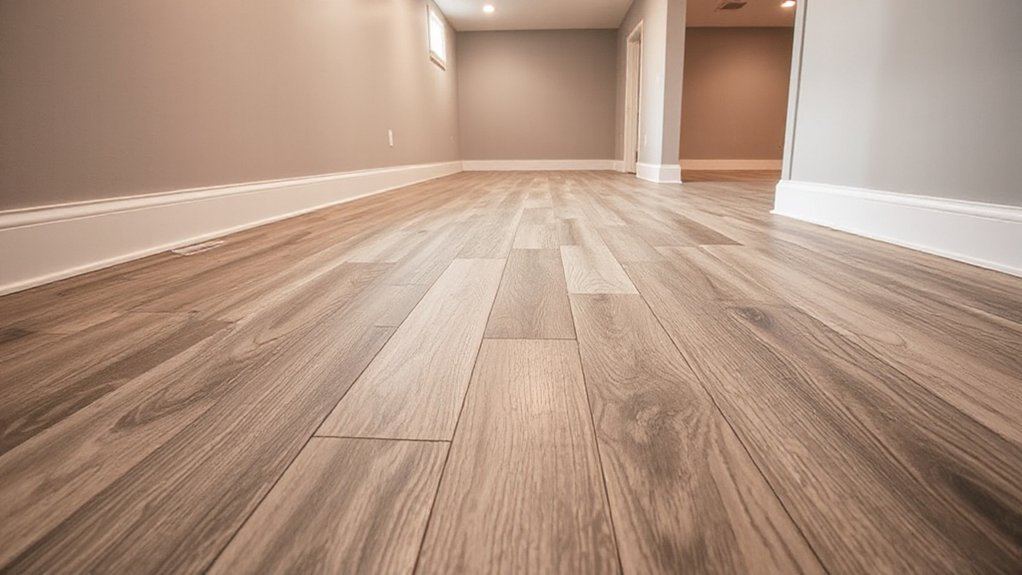

When you’re choosing waterproof laminate for a basement, focus on cores that resist moisture and stay stable: SPC (rigid mineral core) or WPC (wood-based with a cushioning layer), with fiber-reinforced options as a sturdier alternative. Look for tight, robust locking systems, edge sealing, and a subfloor prep plan that includes a vapor barrier and leveling. Match your moisture level to core protection and finish. Ready to explore which options fit your space and budget? You’ll learn more next.
Key Takeaways
- Consider waterproof laminate options with moisture-resistant cores (SPC or WPC) for basement basements, offering stable performance in humidity.
- Choose core materials that minimize swelling and have strong edge seals and locking mechanisms for basement reliability.
- Prioritize underlayment compatible with concrete slabs and vapor barriers to enhance moisture protection.
- Look for durable finishes and beveled edges that hide seams while resisting humidity and wear.
- Assess warranty coverage and moisture ratings (AC ratings) to ensure long-term performance in damp basement environments.
What Waterproof Laminate Is Right for Basements
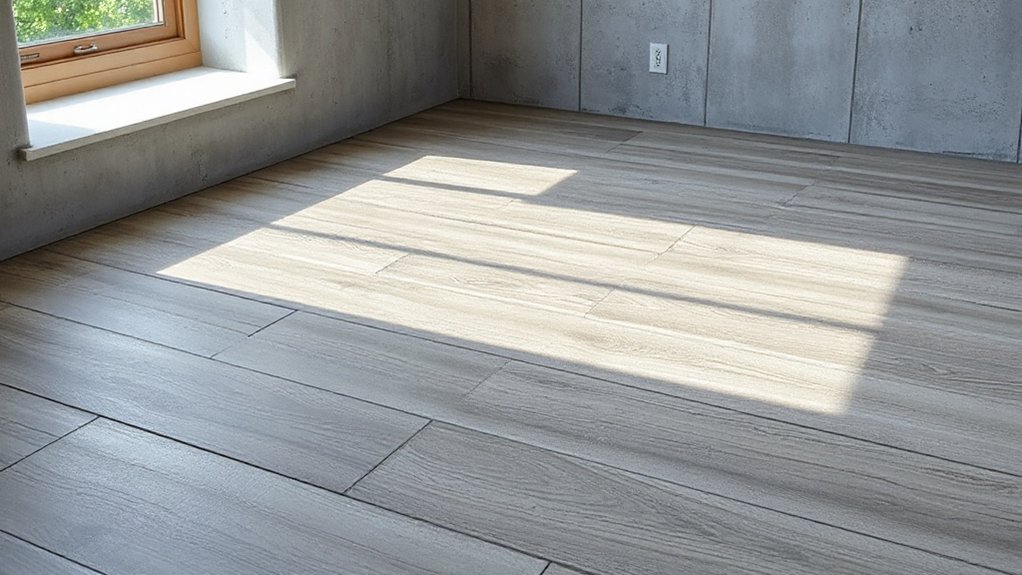
When choosing waterproof laminate for a basement, you’ll want to balance water resistance with subfloor conditions and budget. You select a product with a tight moisture rating and a stable core to minimize expansion from humidity. Look for panels with click-lock joints and beveled edges that resist edge swelling.
Consider edge sealants or pre-applied coatings for concrete or plywood subs, and verify installation guidance for below-grade environments. Opt for higher-density boards to reduce cupping under dampness and temperature shifts.
Prioritize wear layers thick enough to resist denting in high-traffic areas. Color schemes and design trends matter, but compatibility with your existing decor should guide core choices.
Choose straightforward warranties and verify professional installation options align with your basement’s moisture profile.
Core Materials Explained: SPC, WPC, and Fiber-Reinforced Options
Core materials define how a waterproof laminate performs under basement conditions. You’ll compare solid- and recycled-content cores to gauge stiffness, stability, and water tolerance.
SPC (stone plastic composite) uses a rigid mineral core for minimal expansion, excellent dimensional stability, and strong moisture resistance.
WPC (wood plastic composite) blends mineral content with a softer surface layer for comfort underfoot, trading some stiffness for cushioning.
Fiber-reinforced options add post-consumer fibers to fine-tune impact resistance and form stability, often leaning toward more forgiving installations.
Each core shifts overall thickness, click-connection integrity, and subfloor compatibility.
When you weigh design aesthetics and eco-friendly options, consider density, certification, and lifecycle impacts to match basement layout, foot traffic, and maintenance expectations.
How Core Choices Affect Moisture Resistance
Your choice of core material directly affects moisture behavior, so you’ll weigh how each option handles water exposure and humidity swings.
Installation methods also matter: proper sealing, spacing, and underlayment interact with core moisture resistance to protect the subfloor.
Together, these factors guide practical choices for reliable basement performance.
Core Material Moisture Behavior
Core material is the primary factor in a laminate floor’s moisture behavior, so selecting the right core—whether HDF, MDF, or a rigid PVC/stone composite—directly influences swelling resistance, dimensional stability, and tolerance to basement humidity.
You’ll notice moisture behavior differences through swelling limits, creep under load, and fastener compatibility. HDF offers dense water resistance and lower permeation, while MDF can swell more readily if sealed imperfectly, requiring tighter installation tolerances.
Rigid PVC or stone composites excel in rapid humidity shifts, maintaining planarity with minimal grain telegraphing. Material choice also affects edge seal integrity and adhesive compatibility, which in turn governs long‑term performance.
Consider color options and style trends when selecting cores, ensuring the core supports required underlayment and creates predictable moisture response.
Installation Methods Impact
When you install laminate in a basement, the chosen core dictates which moisture-control methods you can rely on and how aggressively you brick up protection against humidity swings.
With a wood-based core, you’ll emphasize vapor barriers, gap spacing, and fastener accuracy to minimize expansion risks.
A stone-plastic composite (SPC) or waterproof core lets you tighten tolerances and reduce underlayment layering, but you still need a proper seal at seams and junctions.
Installation method influences acclimation time, subfloor prep, and adhesive or locking system engagement, shaping long-term humidity resilience.
Consider color options and design patterns during layout to minimize edge exposure and maximize uniformity.
Precision cuts, straight seams, and flush junctions support predictable moisture behavior, ensuring performance aligns with your basement environment.
Key Waterproofing Features for Basements: Locks, Cores, and Edge Protection
Locks seal floors effectively to prevent gaps and water seepage, making installation and maintenance straightforward.
Core materials speak volumes about moisture resistance, so choose options with low moisture absorption and dimensional stability.
Edge protection essentials guard against soaking at panel boundaries, reducing risk of warping and mold growth.
Locks For Sealing Floors
Are you choosing waterproof laminate flooring for a basement, and wondering how locks contribute to a watertight seal? You’ll rely on robust lock mechanisms that align precisely, creating continuous seams that resist moisture ingress.
Sealing techniques matter here: interlock depth, tongue-and-groove fit, and staggered joints all reduce gaps where water could travel. Check that locking profiles are designed to permit tight compression without stressing panels, and confirm installation tolerances match system specs.
Properly used, these locks minimize lift and cupping under damp conditions, keeping panels flat and stable. Focus on compatibility with underlayment, drainage orientation, and edge protection to sustain a reliable seal over time.
- Lock mechanisms enable consistent seam compression
- Sealing techniques optimize water resistance
- Correct alignment supports long-term floor integrity
Core Materials Speak Volumes
Core materials set the baseline for waterproofing performance in basement laminate. You’ll want a core that resists swelling from moisture and maintains dimensional stability under temperature shifts.
HDF and plywood alternatives vary in density, resin content, and fiber orientation; select a core with low water absorption and consistent thickness tolerance.
A rigid, closed-face core reduces nail-head telegraphing and supports edge seals, while a moisture-tolerant core minimizes warping over years of basement humidity cycles.
Consider boards with enhanced edge treatments that align closely during installation, reducing gaps that can trap moisture.
Design aesthetics meet practicality when choosing a core that won’t compromise floor height or underlayment compatibility.
Flooring trends favor cores that balance durability, installability, and moisture resistance without sacrificing performance.
Edge Protection Essentials
Edge protection is where waterproofing meets real-world durability: you’ll rely on tight interlocks, robust cores, and edge seals that resist moisture ingress through every room change. This section focuses on edge sealing and moisture barriers that keep basements dry without sacrificing flooring performance.
You’ll choose profiles with continuous gaskets, corner-to-corner seals, and bevels that minimize capillary wicking. Proper edge protection prevents water from migrating under planks during floods, spills, or humidity swings, while preserving easy installation and long-term stability.
- Guarantee edge sealing runs uninterrupted at every transition
- Verify moisture barriers span joints and underlayment without gaps
- Inspect for compatible cores that resist edge swelling and separation
Best Waterproof Laminate by Basement Moisture Level: Light, Moderate, and High
Choosing the right waterproof laminate depends on your basement’s moisture level: light, moderate, or high.
For light moisture, pick boards with tight joints and a solid core rated for minor dampness; look for color options that keep rooms feeling bright, airy, and practical.
Moderate moisture demands a higher moisture resistance, with thicker planks and robust edge sealing; select designs that hide seams and fit stairs.
While you consider design trends toward neutral tones that resist humidity-induced fading.
High moisture requires a premium warranty and a truly waterproof core, plus subfloor sealing and vapor retarders; prioritize darker colors for masking watermarks and wear.
In all cases, verify WPM, install methods, and compatibility with radiant heat.
Click-Lock vs Tongue-and-Groove: Quick-Basement Installation Basics
Click-lock and tongue-and-groove are the two main installation methods for basement laminate, and each has distinct practical benefits. You’ll install quickly with click-lock, minimizing tool needs, while tongue-and-groove yields tighter seams and a sturdier edge profile.
Consider how each method handles expansion gaps and plank alignment under moisture risk. With color options, you can match decor without sacrificing install reliability, but check fit tolerances and warranty coverage for your chosen system.
For upkeep, guarantee panels interlock correctly to avoid micro-gaps that trap moisture. Select a method that aligns with your basement layout and your skill level, then follow precise sequencing to prevent sagging or edge lift.
Prioritize manufacturer guidance on warranty coverage to secure long-term performance.
- Quick-install convenience vs. seam integrity
- Color options and finish consistency
- Warranty coverage implications and requirements
Underlayment Choices That Boost Basement Moisture Resistance
You’ll want to choose underlayments that both block moisture and dampen sound, so start by evaluating vapor barrier options and their compatibility with your laminate.
Consider how each underlayment handles compression, durability, and the floor’s width, then balance moisture protection with real-world noise reduction.
We’ll compare practical setups that pair vapor barriers with sound-reducing materials to keep basements dry and quieter.
Vapor Barrier Options
What vapor barrier options should you consider to boost basement moisture resistance when choosing underlayment for laminate flooring? You’ll prioritize barriers with high Mohs-like moisture resistance ratings and compatible diffusion rates, ensuring continued vapor control under varying temperatures.
Look for polyethylenes, foil-backed films, or composite sheets rated for sub-slab moisture. Confirm the barrier forms a continuous layer, without gaps, overlaps, or punctures, and that seams are sealed with compatible tape. Check factory certifications for moisture resistance and compatibility with your underlayment and flooring.
Consider a vapor barrier that doubles as a breathable moisture control layer to prevent trapped moisture from degrading adhesive and boards.
- Continuous, seam-sealed installation for reliable moisture control
- Material compatibility with laminate underlayment and subfloor
- Clear ratings for moisture resistance and indoor environment stability
Sound-Reducing Underlayments
Look for closed-cell foams or polymer composites that resist mold and provide stable R-values without compressing under load. Confirm the underlayment is compatible with your chosen laminate locking system and won’t alter panel alignment.
Consider vapor-permeance, density, and thickness to balance subsurface moisture protection with floor rigidity. Color options and surface textures matter for final visuals, so pick a neutral or complementary shade that won’t show imperfections.
Design trends favor breathable, impermeable cores paired with seamless connections, guaranteeing long-term performance and easy maintenance.
Subfloor Prep for Basement Concrete or Slab
Subfloor prep for a basement concrete slab starts with a thorough assessment of moisture, flatness, and cleanliness. You’ll verify moisture via concrete tests, measure high spots with a straight edge, and remove loose debris to guarantee a clean surface for adhesion and consistency.
Any notable cracks get sealed, and high-spot grinding or levelling compounds are applied to achieve a uniform plane.
You consider substrate compatibility with laminate underlayment and moisture barriers, choosing products that tolerate basement conditions while enabling decorative patterns and color options to show through the final look.
Proper cure and acclimation of materials prevent future gaps or buckling under temperature shifts.
- Assess moisture, flatness, and cleanliness; seal cracks and level as needed
- Select compatible underlayment and moisture barrier for basement conditions
- Plan for decorative patterns and color options in the final layout
DIY Basement Waterproofing: Practical Installation Tips
Before you start, identify the moisture source and choose a waterproofing approach that fits basement conditions. For most DIY installs, a combination of a positive-side membrane, proper drainage, and a compatible sealant system works best.
You’ll install a continuous barrier along walls and seams to reduce vapor intrusion before laying laminate.
Check substrate flatness; fill cracks and sand high spots to prevent punctures.
Use a regulated drainage plan, incorporating weep holes or trench drains where necessary, to channel water away from the floor.
Apply adhesive or caulk rated for below-grade use, ensuring compatibility with your chosen laminate.
Decorative patterns and color options should be considered for future matching with trims.
Document test patches first to verify adhesion and moisture tolerance.
Maintenance Tips to Extend Laminate Life in Basements
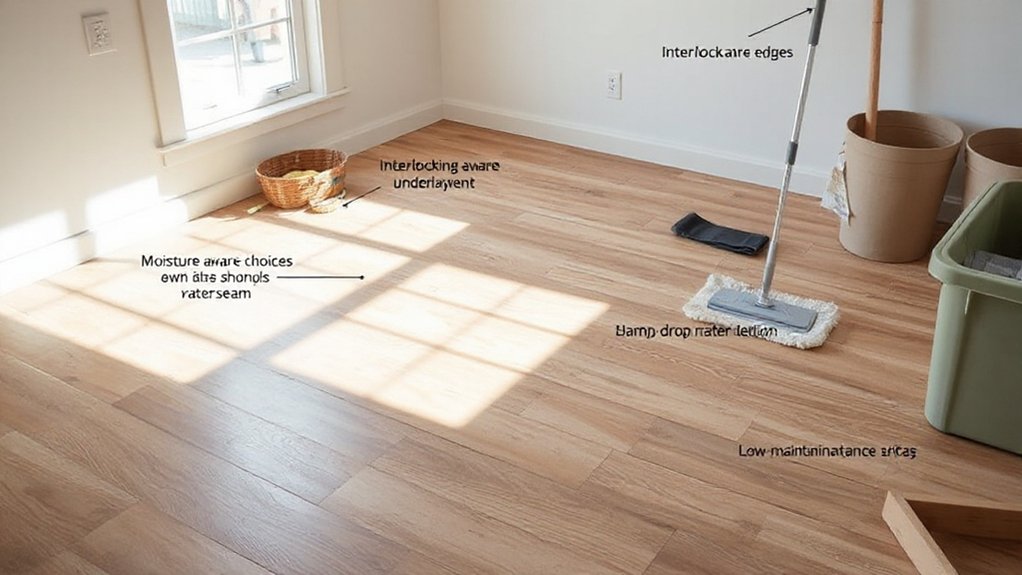
To extend the life of laminate in basements, start with proper moisture control, then maintain a stable environment and use compatible maintenance practices. You’ll protect seams, prevent swelling, and preserve color integrity by pairing humidity discipline with routine cleaning that won’t strain the finish.
Choose mats at entryways to minimize grit, and dry mop after spills instead of wet-wiping. Use compatible cleaners and avoid ammonia-based products that dull coatings. When selecting decorative patterns and color options, verify these details won’t fade under basement humidity fluctuations.
- Monitor humidity and temperature ranges, adjusting HVAC or dehumidification to keep equilibrium.
- Clean with manufacturer-recommended products to preserve wear layer and decorative patterns.
- Schedule periodic inspections for gaps or warping to catch moisture ingress early.
Basement Scenarios and Suitable Laminate Options
Basement conditions vary, and choosing laminate depends on moisture exposure, planned use, and subfloor details; match product specs to those realities to prevent failures. You’ll assess scenarios like high water potential near foundations, elevated humidity, or consistent intermittent dampness.
For walkout basements with occasional splash, select closed-cell, moisture-resistant cores and vapor barriers, prioritizing rigid cores with tight locking to reduce swelling risk. If you plan heavy furniture or traffic, opt for higher wear ratings and impact resistance, aligning with outdoor durability expectations while maintaining manageable installation.
For livable rec rooms, balance aesthetics with resilience, ensuring the finish complements residential aesthetics without sacrificing grip or air quality. In all cases, verify subfloor leveling, include a proper underlayment, and confirm warranty coverage tailored to basement conditions.
Cost Considerations: Budget to Premium Basement Options
When budgeting basement laminate, start with the total installed cost and work backward from core choice, underlayment, moisture protection, and subfloor prep. You’ll balance budget options against durability, warranty, and install complexity, selecting features that fit your space and goals.
Consider how moisture control interacts with ambient use—outdoor furniture and seasonal storage influence dehumidification needs, while kitchen cabinets dictate load considerations and impact long-term maintenance. A midrange core with quality moisture barriers often delivers reliability without overinvestment.
Premium cores add dent resistance and stability for high-traffic rooms, reducing downtime and callbacks.
- Core selection and underlayment compatibility drive long-term performance and price
- Moisture protection quality aligns with space usage, including areas near kitchens
- Subfloor prep requirements affect installation time and total cost
Basement Laminate Comparison: Choose With Confidence
Choosing the right laminate for a basement means weighing moisture resilience, core construction, and finish against your budget and install plan.
In basement laminate comparison, you’ll evaluate core types (HDF vs. plywood), water resistance ratings, and locking systems for reliable underfoot stability.
Consider wear layers and AC ratings to predict longevity in damp environments, plus how underlayment handles vapor diffusion.
Assess installation options: floating vs. anchored structures, room size, and expansion gaps.
Color options influence perceived space and maintenance needs, while aesthetic styles align with your design goals without compromising performance.
Look for boards with tight-allocation tongues, water-infused core protections, and finish coatings that resist scratches.
Finally, verify warranties and repair paths, ensuring replacements align with your selected color options and overall aesthetic.
Frequently Asked Questions
How Long Does Basement Waterproof Laminate Typically Last?
Basement waterproof laminate typically lasts 15–25 years with proper care. You’ll maximize longevity by ensuring moisture resistance during installation and addressing installation challenges like subfloor prep, underlayment, and basement humidity management. Regular maintenance further protects its lifespan.
Can Laminate Be Installed Directly Over Concrete Basement Slabs?
Yes, you can install laminate directly over a concrete basement slab if you prep the surface, fix cracks, and install a moisture barrier. Guarantee proper concrete preparation and check flooring adhesion specs in your product guidelines.
Which Warranties Cover Basement Moisture Damage for Laminate?
Moisture barriers matter, and warranties vary—read the fine print. You’ll typically find coverage against moisture damage under manufacturer warranties, but expect exclusions for improper subfloors, flooding, or basement humidity. Verify limits, claim procedures, and required installation standards.
Does Humidity Alone Affect Laminate Lifespan in Basements?
Humidity alone can shorten your laminate lifespan; humidity effects show up as warping, swelling, or edge lifting, reducing performance. You’ll preserve laminate durability by controlling moisture, using underlayment, and selecting water-resistant products in basements.
Are There Specific Underlayments for High-Moisture Basements?
Yes, you should use moisture barriers or vapor retarders designed for high-moisture basements. They reduce moisture transfer, protect underlayment, and improve laminate longevity by keeping humidity fluctuations under control during installation and in everyday use.
Conclusion
In short, choose a basement-friendly laminate by prioritizing moisture resistance, durable cores, and solid locking systems. You’ll get fewer headaches if you match the board to your moisture level and seal edges properly. I once weighed two sample floors: one with standard core and poor seals, one with SPC and reinforced edges; the latter stayed dry through a basement flood test—like choosing a raincoat with welded seams. Your basement deserves a resilient, leak-ready upgrade.