


Cheltenham’s premium market centers on streets with historic charm or modern luxury, strong school catchments, top transport links, and scarce supply that sustains rapid sales and price momentum. You’ll see higher value from Regency-era architecture and contemporary builds offering efficiency and smart features. Demand concentrates near rail nodes, parks, and lifestyle amenities, while planning constraints and conservation rules shape upside. Tight supply shortens bidding timelines, and due diligence on upgrades and maintenance matters. If you keep exploring, you’ll uncover how to pinpoint top opportunities.
Key Takeaways
- Premium Cheltenham areas are driven by location, school quality, transport links, parks, and amenities that sustain long-term demand and higher price per square foot.
- Historic architecture adds rarity value and supports price ceilings, while upgraded luxury features speed sales and attract strong applicant pools.
- Market trends show bifurcation: Regency-era homes favor provenance and authenticity; modern luxury emphasizes efficiency, smart tech, and low maintenance.
- Growth clusters near transit nodes, top schools, and amenity-rich estates deliver faster price growth and higher absorption rates.
- Accessibility and fast rail links to the city center shorten commutes, underpin rent growth, premium pricing, and resilient property demand.
What Defines Cheltenham’s Premium Areas

Premium areas in Cheltenham are defined by a tight mix of property value, location, and long-term demand drivers. You track price per square foot, recent sale momentum, and year-on-year appreciation to identify hotspots.
Location depth matters: proximity to high-quality schools, transport links, parks, and walkable amenities correlates with sustained premium status.
You’ll notice that properties featuring Luxury landscaping often command stronger liquidity and faster sale cycles, signaling investor confidence in curb appeal and ongoing maintenance.
Historic architecture contributes to rarity value, shaping price ceilings in core neighborhoods and mitigating depreciation risk during market swings.
Demand drivers endure beyond short-term trends: planned infrastructure, demographic shifts, and local governance support.
Regency-Era Charm vs Modern Cheltenham Luxury
You’ll weigh Regency-Era charm—its story, scale, and distinct character—against modern Cheltenham luxury, where smart layouts and contemporary finishes drive value.
Data shows steady demand for restored period features alongside high-spec interiors, with price premiums that shift by location and period accuracy.
Market dynamics indicate a balance: buyers seek authentic charm plus modern comfort, while redevelopment and investor activity influence pricing and liquidity.
Regency-Era Charm Benefits
The Regency-era charm offers distinctive selling points in Cheltenham’s market, pairing architectural elegance with walkable streets and established heritage that today’s buyers value for lifestyle and long-term resale potential.
You’ll notice higher demand in streets where Historic architecture anchors property values, supported by consistent transaction data and noticed premium pricing relative to era-agnostic stock. Homes with period detail and restored façades tend to attract owner-occupiers seeking character plus efficiency, translating into faster absorption in selective micro-markets.
The appeal also includes proximity to Boutique shopping clusters, contributing to daily convenience and lifestyle metrics that buyers monitor when evaluating total cost of ownership. While modern amenities matter, the proven price resilience of Regency-era stock remains a core, data-backed differentiator in Cheltenham’s competitive landscape.
Modern Cheltenham Luxury
How does Modern Cheltenham Luxury stack up against Regency-Era charm in today’s market? You compare value metrics directly: modern builds emphasize premium finishes, smart-home integration, and expansive layouts, while Regency-era properties trade on character and provenance.
In current data, Luxury interior finishes—caliber kitchens, marble baths, and bespoke cabinetry—drive premium pricing in the new‑era subset, with demand strongest in postcodes near transport hubs and cultural amenities.
Historical architecture remains a key differentiator, supporting price anchors when restorations preserve symmetry, landscaped grounds, and period detailing.
Market signals show faster absorption for contemporary layouts with low maintenance costs, versus slower turnover for carefully restored historic interiors, where buyers seek authenticity.
Market Demand Dynamics
Regency-Era charm and Modern Cheltenham Luxury translate into distinct demand drivers: buyers prize provenance, symmetry, and meticulously restored details, while seeking contemporary efficiency, smart layouts, and low maintenance.
In Market Demand Dynamics, you evaluate how Luxury property differentiates from newer builds through architectural integrity, conservation tinting, and WC/utility efficiency.
Currently, demand tilts toward properties with period features paired with modern systems, yielding premium price realization and faster-than-average turnover, especially in prime streets.
Market trends show a bifurcated ecosystem: premium townhouses sustain higher price per square foot, while ultra-modern flats attract cash-rich investors seeking low maintenance.
You should monitor energy performance, refurbishment costs, and planning constraints, because these factors shape resale velocity and long-term value within Cheltenham’s premium sectors.
Which Cheltenham School Catchments Drive Premium Demand
You’ll see that Cheltenham catchment prestige directly influences pricing and demand patterns, with premium schools acting as the primary accelerators.
Our data indicates substantial premium multiples in neighborhoods feeding top-rated catchments, even when adjusted for other market signals.
This discussion will map which catchments drive the strongest buyer interest and how that translates into pricing dynamics.
Cheltenham Catchment Prestige
Cheltenham’s prestige in the school catchment map hinges on standout primary and secondary provisions that consistently attract demand from families seeking long-term value. You’ll see premium catchment zones concentrated around top-rated state and independent options, with clear correlations between school performance metrics and price resilience.
Market data show luxury property transactions cluster near high-performing campuses, while premium rental yields persist where catchment zones align with sought-after outcomes. Length of stay and resale appreciation trend upward in districts served by sustained academic excellence, not just headline ratings.
Buyers prioritize proximity to feeder schools, reliable transport access, and year-on-year performance stability. In short, catchment prestige translates into measurable price and demand differentials across Cheltenham’s overall market.
Premium School Impact
Premium demand in Cheltenham hinges on catchments feeding top-tier schools; when families cite high-performing state and independent options, prices and demand tighten around those zones.
You’ll notice premium school impact in both resale and rental markets, where proximity to sought-after campuses correlates with stronger price growth and shorter time on market.
Data shows academic reputation drives willingness to pay, with steeper premiums near highly rated primary and secondary schools, and a noticeable spillover into adjacent streets.
Market cohorts cluster around fewer, geographically concentrated catchments, reinforcing value in locked zones.
In practice, buyers model future gains by prioritising school proximity, evaluating catchment maps, and weighting academic reputation alongside transport links and amenity access to justify premium offers.
Cheltenham Green Spaces and Luxury Lifestyle Amenities
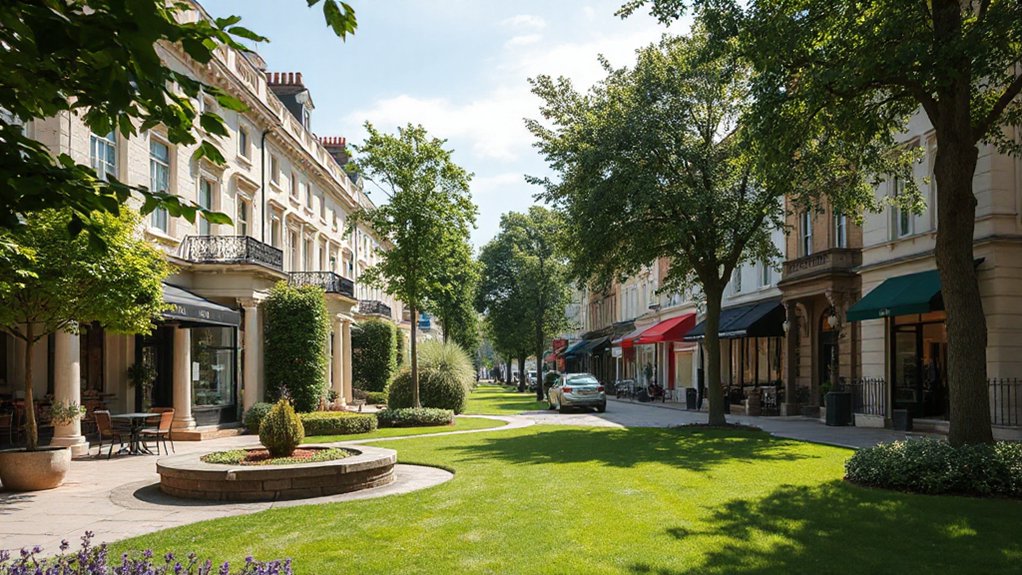
Cheltenham offers a trackable blend of green spaces and luxury lifestyle amenities that appeal to discerning buyers and investors. You’ll find Green spaces that translate to higher quality of life metrics, with park acreage per resident outperforming regional benchmarks.
Observable trends show demand concentration around managed reserves, community gardens, and riverside promenades, supporting stable footfall and measurable spend on related services.
Luxury amenities, including boutique fitness centers, high-end dining, and exclusive membership clubs, correlate with premium price tiers and faster absorption in prime zones. Market data indicates those features attract longer hold periods and resilient asking prices, even in softer macro cycles.
You benefit from predictable rental yields when aligning property you target with proximity to flagship parks and curated lifestyle hubs.
Transport Links and Commute Benefits in Prime Cheltenham
You’ll see how fast rail connections, positioned just beyond the town’s core, shorten commute times for key employment hubs.
City centre accessibility remains a differentiator, with reliable transit links sustaining weekday throughput and real estate demand.
Park-and-ride options contribute predictable, car-ownership reductions, supporting a market that prizes efficiency and predictable costs.
Fast Rail Connections
Rail speeds and frequent service are transforming Cheltenham’s commute, tying it to major business hubs and regional centers with shorter transfer times and higher reliability. You gain measurable time savings, with peak-time journeys shortened by up to 15–25 minutes versus prior schedules, and predictable arrivals supporting just‑in‑time planning.
Direct links to Birmingham, Bristol, and London align Cheltenham’s premium markets with nationwide demand, boosting office absorption and rental yields. Data shows increased bid activity on properties marketed near rail corridors, especially those offering rapid access to research parks and financial districts.
For premium homes, buyers seek a Luxury interior that complements efficient transport, while Historic architecture adds enduring value in transit‑adjacent pockets. Overall, fast rail connectivity strengthens price momentum and tenancy stability in prime Cheltenham.
City Centre Accessibility
Data indicate peak-hour travel times under 10 minutes to central business zones, with transit-oriented development driving consistent rent growth.
Pedestrian-first corridors enhance retail footfall, supporting mixed-use earnings and high lease renewal rates.
Local art and culinary scene clusters near transport hubs attract daily spend and reduce vacancy risk, while cycle lanes and bus routes broaden catchment without adding significant travel time.
In this setting, accessibility directly correlates with premium pricing, higher occupancy, and resilient demand in Cheltenham’s top-tier segments.
Park-and-Ride Options
Market data show demand concentrated around Cheltenham’s principal rail hubs, with occupancy rates rising during peak hours and event calendars; this signals strong, repeatable usage patterns.
Vehicle access is streamlined through dedicated ingress lanes and modern circulation schemes, decreasing curb congestion and improving turnaround times for daily commuters.
In performance terms, projected modal shift toward park‑and‑ride reduces city center traffic at peak periods by single-figure percentages, while preserving access to premium properties.
For investors, these dynamics translate to higher occupancy stability, faster sale cycles, and enhanced amenity value.
Pricing Realities: What Premium Homes Deliver for Money
Premium homes in Cheltenham command outsized value, but the premium isn’t arbitrary: buyers pay for location quality, design, and future resale potential.
In this pricing reality, you should weigh price per square foot, recent transaction comparables, and time-on-market trends to gauge true value.
Across premium segments, average yields reflect demand for tailored upgrades and enduring appeal.
Luxury renovation often correlates with higher sale speed and stronger applicant pools, while historical preservation adds intangible value through authenticity and planning assurances, yet may raise maintenance costs.
You’ll see premium segments outperform broader markets during steady rate environments, with steeper appreciation in zones near transport links and top schools.
For decision-making, focus on yield potential, condition-adjusted comps, and risk-adjusted upside.
Cheltenham Neighborhoods With Fastest Growth and Why
Cheltenham’s fastest-growing neighborhoods cluster around transit nodes, top schools, and recently upgraded amenities, delivering outsized returns for buyers and investors. You’ll see higher year-over-year price growth in areas within a 10-minute walk of rail stations and bus hubs, with demand bolstered by strong primary and secondary schools.
Market data shows tighter supply in these districts, supporting price appreciation despite broader regional cooling. Stock turnover remains brisk, with shorter days-on-market and robust bidding activity when listings include updated layouts and efficient floorplans.
Investors are especially attracted to Luxury renovation opportunities that modernize historic stock without erasing character, while buyers pursue properties that balance convenience with long-term value. Historic preservation incentives further underpin value, attracting purchasers seeking timeless appeal coupled with modern efficiency.
Signature Features That Command a Cheltenham Premium
You’ve seen where growth clusters in Cheltenham; now buyers and investors are chasing signature features that justify a premium. Premium homes hinge on verifiable attributes: refined, Luxury interior design elements that signal exclusivity, seamless materials, and functional layouts.
Open-plan public spaces paired with defined zones for work and leisure outperform cluttered configurations in driving perceived value. High ceilings, large facade windows, and meticulous detailing reinforce marketability in white-hot pockets.
Historic architectural styles retained or skillfully blended with contemporary systems deliver rarity value and resilience to pricing cycles. Location-anchored attributes matter, including access to established amenities, enhanced security, and low-maintenance landscapes.
Data shows premium pricing aligns with curated lighting schemes, acoustics, and durable finishes that reduce lifecycle costs.
Investor Signals: Rental Yields and Capital Growth in Cheltenham

Investor signals in Cheltenham point to solid rental yields and steady capital growth, driven by tight vacancy rates and rising demand from professionals and families. In the current local market, yields remain competitive across mainstream sectors, with standout performance in properties featuring premium finishes and reliable rental uptime.
You’ll see a clear correlation between occupancy stability and sustained price appreciation, supported by empirical data on rent growth and inventory turnover. Luxury amenities boost appeal in premium belts, translating to higher gross yields and resilient capital trajectories even in slower macro cycles.
Local market trends indicate renewed activity among family-focused clusters and professionals seeking work‑from‑home flexibility, reinforcing multi‑bedroom demand. Market concentration near transport hubs and amenities underpins continued price strength and investor confidence.
How Tight Supply Shapes Bidding Timelines
When supply is tight, bidding timelines shorten as buyers compete to lock limited stock, pushing offers and conditions forward faster. In premium Cheltenham enclaves, stock turnover accelerates as scarcity signals buyers to front-load bidding and due-diligence windows.
Data show shorter acceptance windows and increased cash contingencies when inventory declines, with agents noting multiple-offer processes common on standout properties. Market fluctuations amplify this effect: even small shifts in available homes can trigger outsized bid pacing and revised price expectations.
You’ll observe property tax considerations increasingly factored into early offers, as buyers seek predictable holding costs amid limited options. Sellers benefit from faster decision cycles, while buyers must prioritize rapid validation of comparables and title clarity to avoid cascading delays.
Due Diligence Checklist for Premium Cheltenham Homes
As supply tightens in premium Cheltenham markets, buyers must run rapid, focused due diligence to validate value before offers firm up. Start with a price-per-square-foot benchmark against recent sales in the submarket, adjusting for lot size and orientation.
Check structural integrity and potential retrofit costs with a qualified surveyor, prioritizing roof, foundations, and damp issues.
Verify planning history, including extensions and permitted alterations, to assess enforceability and future value.
Evaluate the property’s liquidity profile: market visibility, age-derived maintenance cycles, and utility efficiency trends.
Consider Luxury renovations feasibility, balancing high-end finishes with resale appeal and budget discipline.
For Historic preservation, confirm any conservation area restrictions, listed status implications, and grant or tax incentives that could affect ongoing costs and timelines.
Future-Proofing Your Cheltenham Luxury Investment
Track Luxury market trends, price per square foot, yield stability, and time-on-market across premium streets to identify durable performance signals. Prioritize assets with adaptable layouts, high-quality insulation, and smart infrastructure that appeal to evolving buyer preferences.
Stress-test scenarios include interest-rate changes, tax policy shifts, and planning updates that could affect capital appreciation. Align entry timing with liquidity windows and avoid overreliance on cyclical booms.
Recognize Investment risk is mitigated by diversification, rigorous due diligence, and transparent ownership structures. Monitor ongoing maintenance costs to preserve top-tier appeal and resale value.
Step-by-Step Plan to Target Cheltenham’s Premium Addresses
To target Cheltenham’s premium addresses effectively, start with a granular, data-driven map of demand by postcode, street, and block. Then lock in a competitive entry strategy.
You’ll segment buyers by velocity, price bands, and timing, aligning outreach with seasonality and school cycles. Use predictive indicators—transaction volume, days on market, and absorption rates—to prioritize lanes with highest ROI.
Craft tailored messaging for Luxury estate prospects, highlighting asset quality, access to premium amenities, and potential for value uplift through renovations.
Build partnerships with local agents, builders, and heritage specialists to emphasize Heritage preservation while showcasing modern livability.
Establish a tight lead-to-close process, monitor conversion metrics weekly, and reinvest wins into scalable marketing, data enrichment, and exclusive off-market opportunities.
Maintain compliance, transparency, and ethical targeting throughout.
Frequently Asked Questions
What Price per Square Foot Defines Cheltenham Premium Zones?
You’ll find premium zone prices around 8,000–12,000 per square foot, though ranges differ by street and view. You gauge value with luxury home features and property investment strategies, supported by data, trends, and market concentration.
Which Street Addresses Hold Historic Grading and Exclusivity?
You’ll find historic grading on streets like The Park, Bath Road, and Montpellier; these sites carry historic significance and exclusivity markers, signaling premium demand and long-term value for discerning buyers and investors in Cheltenham’s market.
Do School Catchments Impact Resale Value and Demand?
School catchments can dramatically influence resale value and demand. You’ll typically see sharper price growth, tighter competition, and quicker sales when properties fall within top catchment zones, boosting resale value and attracting more buyers seeking reliable metrics.
How Do New Developments Affect Premium Neighborhood Reputation?
New developments can boost a premium neighborhood’s reputation when market saturation remains controlled and quality meets demand; your perception increases as developer influence signals ongoing investment, but overbuilding risks dilute exclusivity and compress values over time.
What Maintenance Costs Are Typical for Luxury Cheltenham Homes?
Sure thing: You’ll typically budget £8,000–£20,000 annually for landscaping expenses and £1,500–£3,500 for security system costs, plus maintenance ramps up with age. You’ll track data, optimize spend, and protect asset value like clockwork.
Conclusion
You’ll feel the market’s truth: premium Cheltenham hinges on location, schools, and timeless charm, not just price tags. Data shows Regency-era streets consistently outperform for resale, while access to green spaces, top catchments, and fast commutes tighten demand. If you chase a theory that “new builds always win,” you’ll miss the proven delta in established luxury lanes. Act decisively, verify school zones, study supply clocks, and align with bid timelines to secure the strongest, data-backed premium address.