


Swindon’s 2025 growth hinges on strong town-center demand, improved transport, and targeted regeneration. You’ll see solid rental opportunities in the Town Centre, with premiums for prime corridors and high occupancy in walkable zones. Green-light suburbs rise on better connectivity, while the Western Corridor benefits from faster rail and road links boosting demand and cap rates. North Swindon regeneration fuels green spaces and amenity gains, complementing staged equity and affordable financing. Dive deeper to uncover the actionable priorities shaping your portfolio.
Key Takeaways
- Swindon town centre and walkable precincts offer steady rental demand, premium rents, and high occupancy in accessible corridors.
- Green-light suburbs with improved links to town centers boost values, yields, and demand stability.
- The Western Corridor’s enhanced rail/road access enables scalable estates and clear future development.
- North Swindon regeneration drives walkable corridors, new amenities, and rising employment, boosting housing supply.
- Transport upgrades (rail, bus, cycle/pedestrian improvements) expand catchment, reduce commute times, and lift rental attractiveness.
Swindon 2025 Growth Drivers for Investors
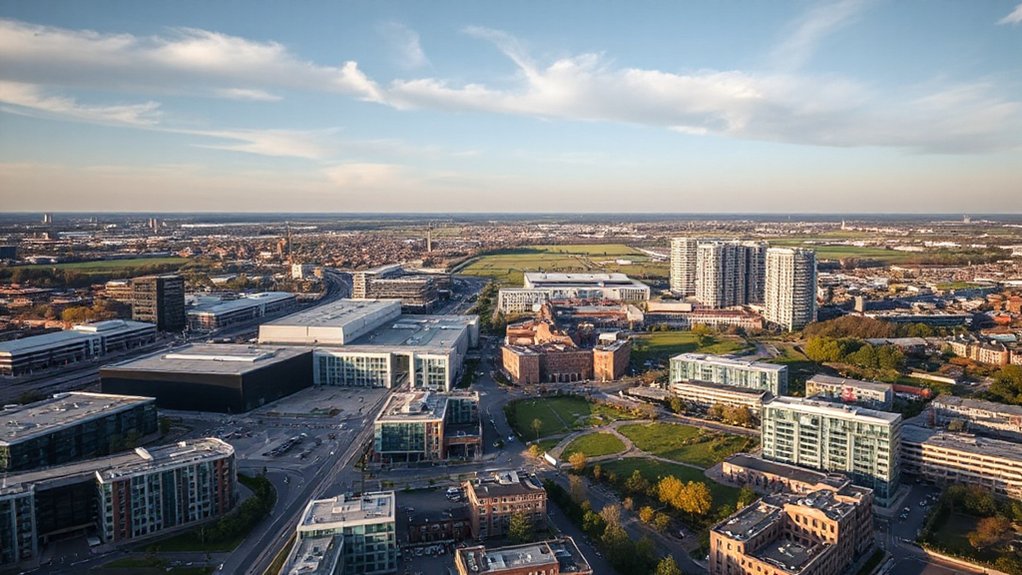
Swindon’s 2025 growth story hinges on three core drivers: sustained demand from housing and commercial development, improving transport links, and a diversified economy anchored by tech, logistics, and life sciences.
As an investor, you’ll note that historical property trends show steady price resilience despite cyclic dips, underscoring Swindon’s supply-demand balance.
Demographic shifts point to a younger, mobile workforce attracted by affordability and proximity to London, Bristol, and the M4 corridor.
You’ll benefit from a broad development pipeline that supports multipliers in residential, office, and industrial sectors, while tech and life sciences clusters attract research talent and funding.
With improving transit and a pro-business policy environment, you’re positioned to capture value from both rental growth and asset appreciation.
Town Centre Rentals: Opportunities and Prices
Town centre rental demand shows steady upside as ease of entry and amenity access attract tenants, supported by vacancy trends and tenant turnover data.
Pricing trends indicate gradual increases with selective premium for best locations, while occupancy remains resilient in high-visibility corridors.
You’ll want to watch for policy shifts, new developments, and medium-term supply that could alter these dynamics.
Rental Demand Dynamics
As urban amenities cluster around town centers, rental demand in Swindon’s core areas is increasingly driven by accessibility, density, and local employment hubs. Occupancy remains high even as new supply enters the market.
You’ll see demand concentrated in walkable precincts, with tenants prioritizing transit links and mixed-use amenities over price alone. Vacancy rates stay modest, signaling resilient absorption even during macro slowdowns.
Market saturation is unlikely to spike soon, given limited central inventory and ongoing development that aligns with commuter patterns. Tenant preferences lean toward flexible layouts, dependable service standards, and proximity to workplaces, schools, and cultural anchors.
Forecasts point to steady rent growth in core zones, tempered by selective diversification in fringe town-center pockets and enhanced amenity delivery.
Pricing Trends Overview
In town centre rentals, pricing trends are tightening around value-driven opportunities, with average rents inching higher as demand concentrates near transit links and mixed-use hubs. You’ll see a narrowing gap between asking and achieved rents, reflecting calibrated pricing strategies that favor occupier certainty and higher turnover.
Market volatility remains detectable, but data shows more resilience when leases include step-ups and performance-based rent reviews. Forward momentum hinges on accessibility, amenity density, and tenant mix, with lenders signaling cautious confidence in well-located portfolios.
You should expect continued modernization of older stock to free up premium pricing. Accessibility-led demand will anchor pricing floors, while new supply tests will calibrate future benchmarks.
- Transit adjacency driving value premiums and faster leasing
- Mixed-use hubs elevating occupancy and rent power
- Step-ups and performance reviews stabilizing returns
- Data-driven adjustments tempering volatility with clarity
Green-Light Suburbs: Connectivity and Value by Neighborhoods

Connectivity is the engine behind Swindon’s Green-Light Suburbs, where each neighborhood’s value rises as links to town centers, rail hubs, and major ring roads improve. You’ll see measurable uplift in property trajectories as access scores climb, supported by faster commutes and predictable service patterns.
Data indicate better-connected pockets attract stable demand, with rental yields tightening where congestion relief and pedestrian cohesion coexist. Suburban sustainability emerges as a concrete differentiator, guiding planning toward mixed-use dynamism and energy-efficient builds that preserve affordability for long-term residents.
You’re observing neighborhood gentrification trends in real time, but targeted infrastructure and zoning policies can mitigate displacement while maintaining value growth. In 2025, connectivity remains the strongest predictor of price resilience and investment appeal across Swindon’s suburbs.
The Western Corridor: Rail and Road Access for Investors
The Western Corridor stands out for rail and road access that directly translates into faster, more reliable investment returns. You’ll see streamlined commutes, reduced logistics costs, and stronger tenant demand as regional links enable daytime and off-peak capacity.
Western corridor connectivity supports scaleable estates, clearer zoning, and predictable occupier workflows, all feeding higher cap rates over time. Rail access remains a differentiator, with improved freight and passenger options boosting site desirability and resale confidence.
- Direct rail access near primary logistics hubs
- Road corridors reducing last‑mile transport time
- Nearby employment clusters boosting occupancy
- Consistent, data‑driven demand signals shaping pricing
Regeneration Hotspots in North Swindon
North Swindon’s regeneration is already reshaping the area, with measurable improvements in housing output, new amenities, and infrastructure upgrades.
Growth projects are driving momentum, attracting investment and boosting footfall in key hubs while tracking revenue and job creation.
You’ll see a data-driven trajectory as these initiatives align with market demand, guiding priorities for future redevelopment.
Regeneration Impacts North Swindon
Regeneration hotspots in North Swindon are reshaping how residents access jobs, services, and housing—driven by targeted investment, new transport links, and mixed-use developments.
- You’ll notice more walkable corridors linking offices, clinics, and schools, cutting commute times.
- Local markets and pop-up spaces showcase urban farming and small enterprises, creating daily anchors for communities.
- Cultural festivals will punctuate the calendar, boosting footfall and sustaining nearby retail.
- Redeveloped green spaces and housing clusters promote density without sacrificing access to outdoor recreation.
Data points point to rising mixed-use density, improved bus frequencies, and higher absorption of new homes within a 15-minute reach.
Forward momentum hinges on coordinated planning, transparent delivery timelines, and measurable community benefits.
Growth Projects Driving Area
Growth projects in North Swindon are accelerating, with targeted investments, new transport links, and mixed-use developments expanding job access, housing supply, and daily amenities. You’ll see urban renewal efforts repositioning town centers and brownfield sites into dual-purpose campuses and housing clusters.
Data shows steady GDP uplift from regeneration hot spots, with projected 2025 employment growth outpacing regional averages. Transport corridors facilitate commuter flexibility, while pedestrian and cycle networks connect residential zones to innovation hubs, retail, and schools.
Market diversification is advancing, reducing single-sector dependence and attracting tech, logistics, and healthcare tenants. You gain clearer timelines, with phase-based milestones and measurable KPIs for construction completion, occupancy rates, and affordable housing quotas.
Affordable Start Homes: Budget-Friendly Paths to Ownership
Affordable Start Homes offer a practical route to ownership by combining lower upfront costs with clear pathways to long-term equity. You’ll see how targeted programs reduce entry barriers while preserving future value, supported by data on price-to-income ratios and grant uptake. This approach aligns with affordability strategies that prioritize sustainable payments, not just badge-price deals.
You can expect predictable monthly costs, stepwise equity build, and clearer eligibility criteria that demystify ownership for first-timers.
- Reduced deposits paired with staged equity access
- Fixed or capped payment plans tied to income growth
- City-backed guarantees boosting lender confidence
- Transparent progress metrics tracking equity and resilience
These insights address homeownership challenges while projecting a healthier, attainable Swindon trajectory into 2025.
Yield Timelines by Swindon Area
You’ll see how Yield Timeline by Area maps to Swindon’s growth windows, with data-driven prompts for prioritizing investments.
As you review Swindon Growth Windows, you’ll compare area-specific timelines, spotting where returns align with market cycles.
This discussion sets the frame for actionable insights on timing and placement across Swindon.
Yield Timeline by Area
Swindon’s yield timelines by area highlight where investor returns are strongest and how they’re evolving over time. You’ll see areas with steady rent growth, anchored by steady demand and mixed housing stock, influenced by historical development and demographic shifts.
The data shows tighter yields in mature districts, expanding slightly in newer zones as occupancy improves and convert-to-rent conversions slow. You’ll notice early signals of rising cap rates in fringe sleeves, driven by commuter access and redevelopment plans.
Overall, expect gradual compression in high-density cores as supply tightens, with pockets of resilience where employment is expanding.
- Historical development ripples shaping current yields
- Demographic shifts nudging demand in key pockets
- New builds elevating occupancy and stabilizing cash flow
- Transit access as a multiplier for rental performance
Swindon Growth Windows
In growth corridors, yields widen as new infrastructure releases demand, while mature zones exhibit consolidation with steadier returns. Historical estate dynamics show earlier peaks, followed by stabilization as supply meets demand, helping you time entry and exit with more confidence.
Local amenities and school catchments correlate with sustained rent growth, narrowing risk. Track windows tied to major projects, then compare area fundamentals to sustain selective exposure across Swindon’s evolving landscape.
Transport Upgrades and Rental Demand in Swindon
Investments in transport upgrades are tightening Swindon’s connectivity, driving quicker commutes and higher housing demand. You’ll see clearer routes, shorter wait times, and a more reliable schedule underpinning rental performance.
Data signals rising occupancy in central and rail-adjacent pockets as public transport access becomes a selling point for tenants. Landlords who align rents with local affordability trends may capture sustained demand, even under shifting market cycles.
- Expanded rail services link Swindon to regional hubs, boosting daily appeal
- Bus network optimization reduces transfer times and expands catchment
- Park-and-ride upgrades cut street congestion around key corridors
- Cycle lanes and pedestrian improvements enhance walkability near stations
Expect continued rent-pressure relief where upgrades meet affordability, strengthening investor confidence in 2025.
Planning Policy Signals for 2025: What Investors Should Watch
Planning policy signals for 2025 will shape investor decisions, especially as local plans tighten housing targets and infrastructure priorities. You’ll want to track how urban planning reforms interact with funding cycles, permitting timelines, and affordable housing mandates.
Look for rising emphasis on mixed-use schemes near transit corridors, which can release higher land values when supported by streamlined approvals. Demographic shifts, including aging populations and first-time buyer activity, will influence unit mix, density, and affordability requirements across Swindon’s neighborhoods.
Monitor draft policies on density caps, green space quotas, and developer contributions, as these will recalibrate return profiles. Prepare scenario analysis around policy rollouts, anticipated timelines, and potential appeals, so you can align capital deployment with targeted growth corridors and planning authority priorities.
Prioritizing Swindon Growth Areas for Your Portfolio
To capture upside, map growth-area performance against planning signals you’ve just reviewed. You’ll prioritize zones with observable demand signals, credible supply plans, and improving affordability trajectories.
Focus on areas where affordable housing maintains balance with market rents, and where local amenities anchor longer-term value. Track vacancy trends, unit completions, and infrastructure progress to forecast concentration of growth.
Prioritize diversification across price bands to manage risk while preserving upside. Align weightings with a data-driven thesis that favors areas showing consistent throughput of buyers and renters, not just hype.
- Visible affordable housing initiatives paired with rising local amenities
- Clear planning-consent pipelines and timely completions
- Strong transport links boosting commuter appeal
- Balanced occupancy rates across price tiers, not just luxury segments
Frequently Asked Questions
Which Specific Neighborhoods Offer the Best Overall ROI in 2025?
You’ll see the best ROI in neighborhoods with ongoing revitalization and rising property appreciation. Target areas prioritizing infrastructure upgrades and mixed-use development, because data shows stronger demand, faster turnover, and higher appreciation trajectories through 2025.
How Will Tax Changes Affect Swindon Buy-To-Let Profitability?
Tax changes will squeeze margins, you’ll face higher stamp duty costs and tighter relief, yet you’ll still optimize profits by timing sales for capital gains and leveraging tax relief strategies to protect net rental yields in Swindon.
What Loan Products Suit Swindon Investors in 2025?
Mortgage options abound for Swindon investors in 2025, you’ll want clarity on rates and terms. You’ll prioritize refinancing strategies, compare fixed vs. variable, and choose products aligned with cash flow, leverage, and forward-looking market data.
Which Infrastructure Projects Most Impact Rental Yields This Year?
Public transport upgrades and road improvements most boost your rental yields this year, as accessibility rises and demand tightens. You’ll see price per pound grow where transit reliability and commute times shorten, guiding you toward high-yield investments.
Are There Leasehold Reforms Affecting Swindon Property Values?
Placing you at a crossroads, leasehold reforms reshape property tenure, narrowing costs and uncertainty. You’ll see tighter controls and clearer timelines, boosting confidence and potentially values in Swindon as data points trend toward stabilized, investor-friendly property tenure.
Conclusion
Swindon’s growth story is undeniable: new rail and road links, regeneration hubs, and rising rents converge where demand meets supply. You should tilt portfolios toward North Swindon and the Western Corridor while watching planning signals for 2025. Yield timelines tighten as transport upgrades facilitate higher occupancy. Think data-first: model neighborhoods by regeneration pace, connectivity, and school/amenity access. The future favors proactive, diversified investors who ride infrastructure-led growth—before the market fully prices it in.