
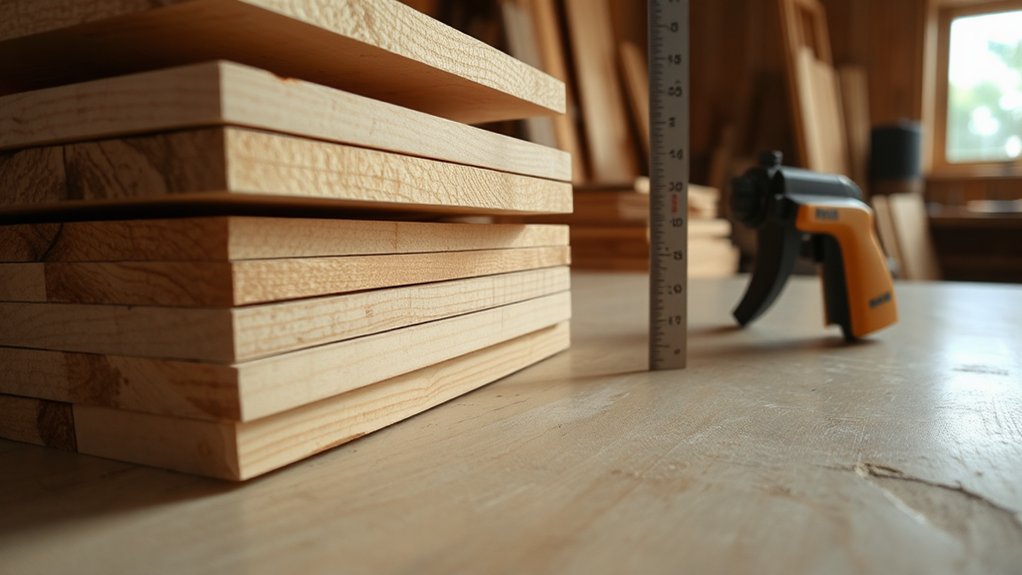

Understanding nominal versus actual lumber sizes is essential for precision. Nominal sizes are the standard labels you use to select stock, while actual sizes are the real measurements after planing, drying, and milling. Always verify actual dimensions before cutting to guarantee joints fit and framing aligns. Decode stickers to confirm nominal size, grade, species, moisture, and treatment. When you plan joints, account for the size gap and grain orientation, then re-measure after acclimation. If you keep going, you’ll master accurate, predictable builds.
Key Takeaways
- Nominal sizes are standard labels; actual sizes are the real dimensions after drying and milling, so verify before cutting.
- Stickers encode nominal size, grade, species, moisture, and treatment; cross-check with project specs for accuracy.
- Size gaps affect cuts and joints; adjust plans to preserve fit, strength, and alignment based on actual dimensions.
- Convert nominal to actual using standardized charts and on-site moisture checks to ensure precise joints.
- Budget for waste, grading variance, and moisture-related changes; keep 5–10% contingency for substitutions.
What Nominal Vs Actual Sizes Mean for Your Project

Nominal sizes are the measurements wood is commonly labeled with, while actual sizes are what you’ll end up with after planing, drying, and milling. In practice, you’ll select lumber based on nominal dimensions to fit standard framing and joinery, but you must verify actual sizes before cutting.
Lumber grading informs strength and suitability for load-bearing applications, so you’ll rely on grade stamps and species data to match performance to your design.
Moisture content directly affects fit, finish, and dimensional stability, so you’ll measure it and account for shrinkage expectations during planning.
Converting from nominal to actual ensures you don’t overcut or underspecify joints. By aligning lumber grading with moisture content, you minimize surprises in field assembly, preserving structural integrity and achieving consistent results throughout the project.
Decode Lumber Stickers: Read Nominal Vs Actual Sizes
Sticking with the theme of sizes you’ll rely on in the shop, decoding lumber stickers means translating the label’s numbers into real-world dimensions. You’ll verify that nominal sizes differ from actual measurements, and you’ll use the sticker because it encodes grade, species, moisture content, and treatment if applicable.
Focus on Lumber grading details, which indicate the board’s strength and suitability for specific assemblies, not just thickness or width. Read the printed dimensions alongside the declared nominal size to avoid surprises at the saw or joint.
Note moisture content, a critical factor influencing planing, drying, and in-service performance. By cross-checking sticker data with your project specs, you ensure consistent stock, predictable behavior, and safer, more reliable builds.
How the Size Gap Changes Cuts and Joints
When the size gap between nominal and actual lumber dimensions shifts, cuts and joints respond accordingly. You adjust your plan to maintain fit, strength, and alignment, accounting for the new truth about stock.
Grain orientation guides how you saw and joint; a shift can alter tendency to pinch or tear out at critical edges, so you re-check reference faces before finalizing a cut.
Moisture content drives traceable changes in thickness and stiffness, so you re-measure after acclimation and before assembly to preserve tolerances.
In joinery, you favor fit-and-gap precision, not force, to avoid misalignment.
In framing, you anticipate varied sag with different species and moisture histories, choosing connectors and methods that tolerate occasional deviation.
Your results depend on disciplined measurement, repeatable setups, and documentation.
Convert Nominal to Actual: Charts and Quick Methods

Convert nominal sizes to actuals quickly with solid, field-tested charts and proven quick methods. You’ll convert common nominal-plus-actual relationships at a glance, guided by standardized lumber grading practices and real moisture content impacts.
Keep a tight focus on face dimensions, subtractive allowances, and seasonal wood behavior to avoid misinterpretation in production runs. Use validated charts to map nominal to actual without guesswork, then verify with on-site checks and moisture content readings.
Pair these methods with clear callouts for species and grade, so discrepancies don’t derail assemblies or finish work. The result is reliable, repeatable sizing that supports precise joints and predictable performance in the field.
- Quick-reference charts for common species and grades
- Moisture content adjustments and tolerance notes
- Nominal-to-actual examples you’ll actually use
- Verification steps to prevent miscuts and rework
Pitfalls and Budgeting Tips for Real-World Lumber
Even with solid charts and quick methods, real-world lumber work remains prone to hidden costs and avoidable mistakes; anticipate them upfront to protect project budgets.
You’ll encounter variance in lumber grading, which directly affects strength, fit, and finish, so verify grade stamps and supplier specs before purchase.
Plan for waste factors, seasonal stock discrepancies, and miscuts by sizing up your material allowance in the bill of materials.
Wood moisture matters profoundly; kiln-dried vs. air-dried choices shift price and performance, so confirm target moisture content for your application and adjust design tolerances accordingly.
Source consistency from a reliable mill, and document batch IDs to track deviations.
Finally, build a contingency of 5–10% on premium stock for unplanned substitutions, reducing schedule risk and budget overruns.
Frequently Asked Questions
How Do Moisture Content and Seasoning Affect Nominal Vs Actual Sizes?
Moisture content and seasoning shrink lumber, altering actual size while nominal remains fixed. Moisture calibration and seasonal variation drive dimensional changes, so you must account for moisture content when fitting components and tolerances in every project.
Are There Regional Differences in Standard Lumber Dimensions?
Regional standards do vary by region, so you’ll see lumber variability across jurisdictions. You use local grade stamps and dimensions, acknowledging that practical sizes diverge from nominal charts, constrained by regional manufacturing norms and market expectations.
Do Engineered Lumber Products Follow the Same Nominal-Actual Gap?
You’re right: engineered lumber generally follows a clear nominal-actual gap, but it’s tightly governed by lumber grading and manufacturing standards. You’ll find tighter tolerances, consistent specifications, and fewer regional quirks when evaluating performance and DIN/CSA-like benchmarks.
How Do Waste and Kerf Influence Final Project Dimensions?
Waste and kerf shrink final dimensions: you must account for Lumber shrinkage and Cutting precision to guarantee fit. You’ll compensate by planning for material losses, trimming allowances, and specifying precise cuts to maintain structural accuracy and alignment.
Can You Resize Lumber to Match Exact Measurements Safely?
Yes, you can resize lumber, but you must do it carefully. Lumber resizing requires accurate cutting and planing, plus consistent checks. Follow safety considerations, wear protection, secure the work, and verify dimensions before installation.
Conclusion
You’ll love the lumber puzzle: nominal sizes promise grandeur, actual sizes quietly shrink your plans. You read stickers like a sage, then realize your cuts need a math degree you don’t own. Yes, the gap saves you money—until it doesn’t. You convert, you measure, you adjust joints, you budget for waste, you still end up respecting the sticker’s deceit. Welcome to woodworking: where percentages, not dreams, govern your project’s destiny. Irony, meet industry.