

A privacy fence can elevate your outdoor space by balancing seclusion with style. Start by clarifying your main goals—privacy, noise reduction, or visual screening—and assess site factors like wind, sun, and drainage. Choose a style that fits your landscape: timber for warmth, metal for durability, or hybrids for strength with a refined look. Plan for security, lighting, and plant integration, plus easy maintenance. If you keep exploring, you’ll uncover practical setup tips and real-world layouts.
Key Takeaways
- Choose a privacy fence style that matches your landscape and maintenance preferences, from timber warmth to durable metal or hybrid options.
- Incorporate screen elements (poly panels, woven materials, or lattice) to balance privacy with airflow and light.
- Integrate living walls, planters, and trellises to soften boundaries and add greenery without crowding space.
- Elevate security and durability with solid panels, reinforced posts, hidden hardware, and appropriate gate seals.
- Enhance ambiance with lighting accents, decorative caps, and layered noise-reduction features for a comfortable outdoor environment.
Decide What You Need: Key Questions Before You Choose a Privacy Fence

Before you choose a privacy fence, clarify what you actually need. You’ll map priorities by considering how you use outdoor space and what must stay private. Ask where you want seclusion, what noise or sightlines matter, and how much maintenance you’ll tolerate.
If you value entertaining, plan for a layout that accommodates garden furniture and easy traffic flow. If pets or kids play nearby, prioritize durability and safety features.
Consider lighting needs for evenings and whether outdoor lighting should highlight features or provide security. Evaluate wind, sun exposure, and privacy height without creating a fortress feel.
Finally, align your goals with budget, installation time, and compatibility with existing landscape elements to avoid surprises later.
Pick Your Fence Style: Timber, Metal, or Hybrid
When choosing your fence style, weigh timber, metal, and hybrid options against your privacy goals, maintenance tolerance, and budget.
Timber offers warmth and natural texture, blends with landscapes, and suits traditional design aesthetics.
Metal fencing provides clean lines, durability, and a modern edge, with low upkeep if you select coated or powder-coated options.
Hybrids combine timber frames with metal infill for a balanced look and strong security, while still delivering visual appeal.
Consider installation complexity, long-term costs, and weather resilience as you compare fencing materials.
Your choice should align with your landscape’s design aesthetics and your daily routines, from hosting to quiet evenings.
In short, pick a style that meets privacy priorities, durability expectations, and budget realities.
Climate and Maintenance: What Your Fence Must Withstand
Climate and maintenance go hand in hand with your fence choice, because the right design must withstand weather while fitting your routine. You’ll prioritise material durability, selecting options that hold color, resist rot, and endure temperature swings without warping.
Assess your climate: humidity, salt exposure, freeze-thaw cycles, and sun. Choose sturdy constructions and protective treatments that align with your upkeep capacity—stains, sealants, or periodic painting.
Regular inspections catch loose boards, worn fasteners, and gap changes before issues compound. Clean surfaces to prevent mold and mildew buildup, especially in shaded or damp areas.
Consider drainage around posts to avoid water pooling. When you pair resilient material with sensible maintenance, fence aesthetics stay sharp, and overall longevity improves without excessive effort.
Privacy Without Feeling Closed In: Screen Options That Work

You can maintain privacy without feeling boxed in by choosing light-filtering screens that soften sightlines while preserving air flow. Think airy textures and open-feel designs that blend with your yard, so you get seclusion without a boxed-in vibe.
We’ll explore options that balance privacy, ventilation, and visual openness, starting with sizes, textures, and placement strategies.
Light-Filtering Screen Options
Light-filtering screens strike a smart balance between privacy and openness by letting light in while maintaining sightlines to the outdoors. You’ll improve a yard’s ambiance without closing it off, using textures that blur silhouettes while keeping views intact.
Choose options that respond to sun angles and weather, so you control glare and humidity with ease. Integrate smart technology to automate shade levels and timing, or pair panels with decorative lighting to set mood after dusk.
Filtered daylight reduces glare on screens and furniture, enhancing comfort and usability.
- Translucent polycarbonate panels
- Woven privacy screens
- Perforated metal sheeting
- Fabric-weave screens
- Bamboo or reed rolls
Airy, Open-Feel Privacy
Open, breathable privacy can still feel open to the outdoors. You can achieve an airy, open-feel without sacrificing seclusion by choosing lightweight screens that let daylight drift through.
Opt for decorative lattice inserts or slats spaced to limit direct sightlines while maintaining air circulation. Use vertical panels with gaps that frame views rather than block them, creating a sense of openness along walkways and seating areas.
Pair these screens with subtle fence lighting to extend evenings without overpowering the space. Where privacy is needed, place planters or climbing vines at edges to soften boundaries without dense walls.
This approach keeps your outdoor room feeling connected to nature, practical for entertaining, and easy to maintain.
Barrier Strength and Noise: How Fences Quiet Your Outdoor Space

Fences aren’t just boundaries—they dampen sound by using solid materials and thoughtful gaps that break up noise paths. You’ll notice better privacy when you choose barriers with dense panels, tight seams, and taller heights.
These features are paired with design details that disrupt sound reflections. We’ll explore how barrier strength and smart construction techniques reduce noise and improve outdoor comfort.
Barrier Sound Dampening
A well-placed fence can substantially reduce outdoor noise by interrupting sound paths and absorbing energy before it reaches your space. Barrier sound dampening hinges on thoughtful design and materials that deliver real acoustic benefits. You’ll benefit from considering surface density, mass, and airtight joints to maximize Soundproof barriers and Acoustic insulation.
- Choose opaque panels with high mass and minimal gaps
- Integrate staggered boards or dampening slats to disrupt reflections
- Add a soil-backed base or planting bed to enhance low-frequency absorption
- Use corner posts and tight seals for reduced leakage
- Pair with exterior insulation where feasible for layered performance
With a practical selection, you’ll create a calmer, more usable outdoor area while preserving aesthetics and privacy.
Noise Reduction Techniques
To reduce outdoor noise effectively, you should focus on barrier strength and sound-damping design that disrupts, absorbs, and seals against sound leakage.
In practice, you’ll compare materials for mass, density, and resonance, because heavier, denser panels generally perform better at blocking sound. Consider rigid construction that minimizes gaps and air gaps, since leaks undermine effectiveness.
Evaluate installation details: tight joints, acoustic seals, and proper drainage to prevent sound pathways.
Balance performance with aesthetic considerations, choosing finishes and textures that suit your space while maintaining continuous mass.
Materials comparison reveals tradeoffs between wood, composite, vinyl, and concrete options; none are one-size-fits-all.
Pair resilient cores with absorptive linings and decorative screens to soften reflections, achieving calmer outdoor zones without sacrificing style.
Patterns and Privacy Levels: Visual Cues for Every Backyard
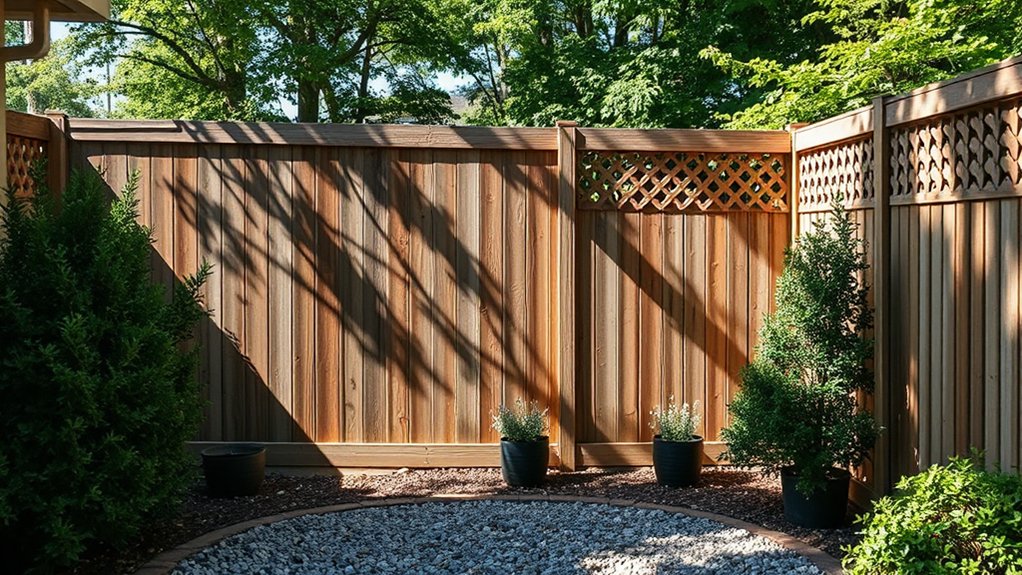
Patterns and privacy levels aren’t one-size-fits-all; by mixing board heights, spacing, and materials, you can cue different degrees of seclusion while keeping your yard visually inviting.
- Use varied board heights to create partial sightlines without blocking light or airflow.
- Alternate spacing to suggest intimacy in seating zones while preserving openness.
- Pair contrasting material textures for tactile cues of enclosure.
- Employ decorative motifs on panels to signal privacy intent without heaviness.
- Layer fencing with transparent inserts or lattice accents to balance openness and seclusion.
Greenery and Integration: Living Walls and Planter Options
Living walls offer scalable privacy while adding texture and sound dampening, with options ranging from modular panels to vertical gardens.
Planter integration ideas help you blend greenery with existing structures, including railings, fences, and corners, so installation stays clean and secure.
For ongoing care, we’ll cover maintenance tips for different greenery types and simple schedules to keep your living elements thriving.
Living Wall Options
Ever considered how a living wall could transform your privacy fence into a living, breathing feature? A well-planned wall blends greenery with structure, boosting privacy while boosting curb appeal.
Focus on modular panels, smart irrigation, and drought-tolerant species to minimize maintenance.
For urban integration, choose compact varieties that don’t overwhelm narrow spaces, and install trellises that guide vines along vertical lines.
Wildlife compatibility matters—select nectar-rich blooms and sheltering foliage to attract beneficial insects and birds.
Prioritize drainage, wind resistance, and accessibility for seasonal care.
- Modular panels for flexible layouts
- Drip irrigation with rain sensors
- Native, pollinator-friendly species
- Trellis-guided vine growth
- Low-maintenance, drought-tolerant plants
Planter Integration Ideas
Planter integration expands your privacy strategy by pairing built-in greenery with the fence structure, creating a seamless, low-maintenance glow of foliage. You’ll optimize space with smart planter placement, choosing compact containers that suit your fence line and breeze flow.
Start with modular units that snap into existing posts, then layer textures from trailing vines to upright specimens. Vertical gardening lets you maximize height without widening footprints, using trellises, pocket planters, or wall-mounted boxes to feature seasonal color.
Select drought-tolerant, native species for resilience and ease. Consider drainage, irrigation compatibility, and wind exposure to prevent waterlogging or plant damage.
Periodically rotate focal plants to maintain visual interest, and group by light needs to sustain a cohesive, thriving display.
Greenery Maintenance Tips
To keep greenery around your fence thriving, establish a simple, repeatable maintenance routine that matches your local climate and plant selections. You’ll sustain healthy growth with a practical approach that emphasizes structure, timing, and accessibility for ongoing garden layout optimization and seasonal pruning.
Apply targeted care to living walls and planters, ensuring water, light, and airflow are balanced for each species.
- Inspect weekly for pests, disease, and drooping foliage
- Water consistently, adapting to rainfall and soil type
- Prune seasonally to encourage shape and airflow
- Fertilize lightly to support growth without oversaturation
- Reassess plant placement as seasons shift and new growth emerges
Height, Codes, and Property Lines: Navigating Regulations
Understanding local height limits, codes, and property lines is essential before you install a privacy fence. You’ll want to verify municipal ordinances, homeowner association rules, and setback requirements that affect Fence height and placement.
Start by identifying property boundaries and easements so you don’t encroach on a neighbor’s space or utility line. In many jurisdictions, fence height is measured from grade, and the top edge must be parallel to the ground—yet exceptions exist for visibility at driveways or corners.
Gather permits, if required, and prepare clear plans for review. Consider sight lines, drainage, and future landscaping when locating posts.
Safety and Security Features to Consider

Think about practical security upgrades that fit your fence type, like tamper-resistant hardware, reinforced posts, and concealed hinges that deter access. Consider simple safety enhancements such as anti-climb features, integrated lighting, and smart monitoring to deter intruders and aid visibility.
We’ll explore how these security features and safety upgrades align with your goals, budget, and local regulations as you plan your privacy fence.
Security Features To Consider
When evaluating privacy fence ideas, prioritize security features that deter intrusion and withstand weather. You’ll want components and practices that create reliable barriers while aging gracefully under sun, rain, and wind.
Consider how design choices affect privacy and access control, and align with local requirements for a smooth installation. Stay aware of privacy laws and fencing permits to avoid delays or fines.
- Solid, tamper-resistant panels with secure fasteners
- Hidden hinges and latching mechanisms for restricted access
- Anti-climb tops or angled caps to deter over-the-wall attempts
- UV-stable finishes and rot-resistant framing for longevity
- Integrated lighting and visibility-enhancing landscaping for deterrence
Choose materials and methods that balance privacy, maintenance, and compliance for lasting, practical security.
Safety Enhancements For Fences
What safety enhancements can make your fence both tougher and smarter? You’ll choose deterrents that blend with your design, not disrupt it. Start with reinforced posts and higher-grade hardware to boost material durability, reducing wobble and corrosion.
Add anti-climb features or angled tops that deter intrusion while preserving curb appeal. Integrate smart options like tamper alarms or camera mounts discreetly, so security updates don’t clutter the line.
Guarantee proper gate seals and latching mechanisms to prevent drafts and accidental openings. Lighting should be low-glare and fixture-to-fence aligned, supporting Fence aesthetics without harsh hotspots.
Consider powder-coated finishes for long-lasting resilience against weather. Regular inspections catch loosened screws or rust early, preserving safety, functionality, and your investment.
Budget and Value: Cost-Breakdown by Material and Install
Budget decisions for a privacy fence hinge on material choices and installation. You’ll weigh upfront costs against long‑term value, focusing on durability, maintenance, and resale appeal. Here’s a practical breakdown to guide your cost comparison:
- Fence material: wood, vinyl, composites, metal, or bamboo
- Installation: professional labor vs. DIY feasibility and time
- Longevity: painted wood vs. rot‑resistant alternatives
- Maintenance: staining, sealing, cleaning, or coating frequency
- Resale impact: curb appeal and perceived security
Understanding these factors helps you maximize value without overpaying. Track upfront price tags, then project longer‑term expenses across a decade.
With a clear cost framework, you’ll select a material and install approach that aligns with your budget and lifestyle, delivering reliable privacy and style. Fence material and cost comparison remain your guiding metrics.
DIY vs. Pro Install: Pros, Cons, and When to Hire
Choosing between DIY and professional installation hinges on your priorities for time, quality, and hassle. DIY can save money and let you schedule work around your calendar, but it demands skills, permits, and patience—especially if you tackle fence painting or adding wildlife deterrents yourself.
Pro installation offers speed, guaranteed alignment, and warranty-backed results, but at higher upfront costs and less control over every detail. Consider fence height, substrate, and local code requirements to decide which path minimizes risk.
If you’re handy and resources are limited, a staged DIY approach can work, leaving complex sections to pros. For projects that demand durability and consistent finish, hire a professional to ensure long-term performance and avoid costly fixes later.
Finishes That Elevate: Posts, Caps, and Detail Treatments
Finishes that elevate a privacy fence start at the posts, caps, and the subtle detail treatments that bond the whole look. You’ll choose materials and profiles that resist weather, then add caps and accents that read as intentional design. The right combination elevates durability, style, and curb appeal, while keeping the fence cohesive with your landscape.
Consider practical details like moisture seals, UV protection, and consistent grain direction. Use decorative finials sparingly to mark transitions without clutter. For lighting, plan fence lighting to highlight posts and cap lines at dusk, balancing brightness and shadow. A clean, precise finish reduces maintenance and emphasizes craftsmanship.
- Fence lighting for post accents
- Decorative finials as subtle punctuation
- Weather-resistant cap options
- Consistent stain or paint scheme
- Clean seams and joint detailing
Real-World Setups: Case Studies for Small and Large Yards
Across small and large yards, real-world setups reveal how the same design principles translate to different footprints. You’ll see compact layouts leverage vertical planes and stepped panels to maximize enclosure without crowding space, while large yards embrace layered screens and pergola accents to soften edges and add functional zones.
In tighter lots, you prioritize fence durability with weathered-grade boards and solid rails, then pair with visual breaks like lattice to maintain air flow. For expansive sites, you can extend runs, vary heights, and integrate screening trellises to create intimate corners.
Consistency matters: repeat material and color for cohesive aesthetic appeal, even as configurations shift. These case studies prove practical application, clear maintenance of privacy, and predictable performance in real-world use.
Maintenance Routine: Keeping Your Privacy Fence Sharp and Lasting
Regular upkeep keeps your privacy fence performing at its best and looking sharp. To keep it lasting, you’ll implement a simple, repeatable routine that protects material and appearance.
- Inspect quarterly for loose boards, screws, or nails and tighten as needed.
- Clean with a mild soap solution to remove dirt and mildew.
- Seal or stain every 2–3 years to prevent moisture damage.
- Check posts for stability and address any ground settling.
- Add fence lighting and decorative accents to boost curb appeal and deter intruders.
A proactive approach saves costs, reduces repairs, and keeps you smiling at your outdoor space.
Consistency matters more than intensity, so stick to the schedule and your fence will endure.
Frequently Asked Questions
How Long Does a Privacy Fence Typically Last?
A privacy fence typically lasts 15 to 25 years, depending on materials and maintenance. You should plan routine fence maintenance, inspect for rot, and guarantee correct privacy fence height. Proper upkeep extends life and preserves appearance.
Which Fence Type Offers Best Privacy per Dollar?
You’ll get the best privacy per dollar with solid wood or vinyl, depending on climate; choose material options that balance upfront cost and durability. Do a thorough cost comparison, including maintenance, to select the long‑term value for your yard.
Can Fences Affect Property Value or Resale?
Yes, fences can influence property value and resale. You’ll address privacy concerns, define neighbor boundaries, and boost curb appeal, but over-invest or poor craftsmanship may hurt value. Choose durable materials, proper height, and professional installation for best results.
Are There Noise-Reduction Limits for Fences?
Yes, there are practical limits and guidelines. You’ll typically target a noticeable reduction with solid barriers, not absolute silence. Consider soundproofing options and noise barrier materials, tuned to your space’s size, layout, and nearby noise sources.
Do HOA Rules Restrict Fence Materials or Colors?
HOA design often restricts fence materials or colors; you’ll probably need approval before installation. You, though, can plan within guidelines, focusing on fence aesthetics and compliance to avoid surprises, and still achieve a polished, practical privacy solution.
Conclusion
You’ve got the blueprint to choose a privacy fence that fits your space, climate, and vibe. Think through needs, style, and maintenance, then weigh DIY pride against pro precision. Balance privacy with openness using smart screen options, and pick finishes that stand up to weather. Case studies prove small yards can feel expansive and big yards intimate. Keep a simple maintenance rhythm to protect your investment. Now channel your inner Tony Stark—modern, efficient, timeless.